Guide
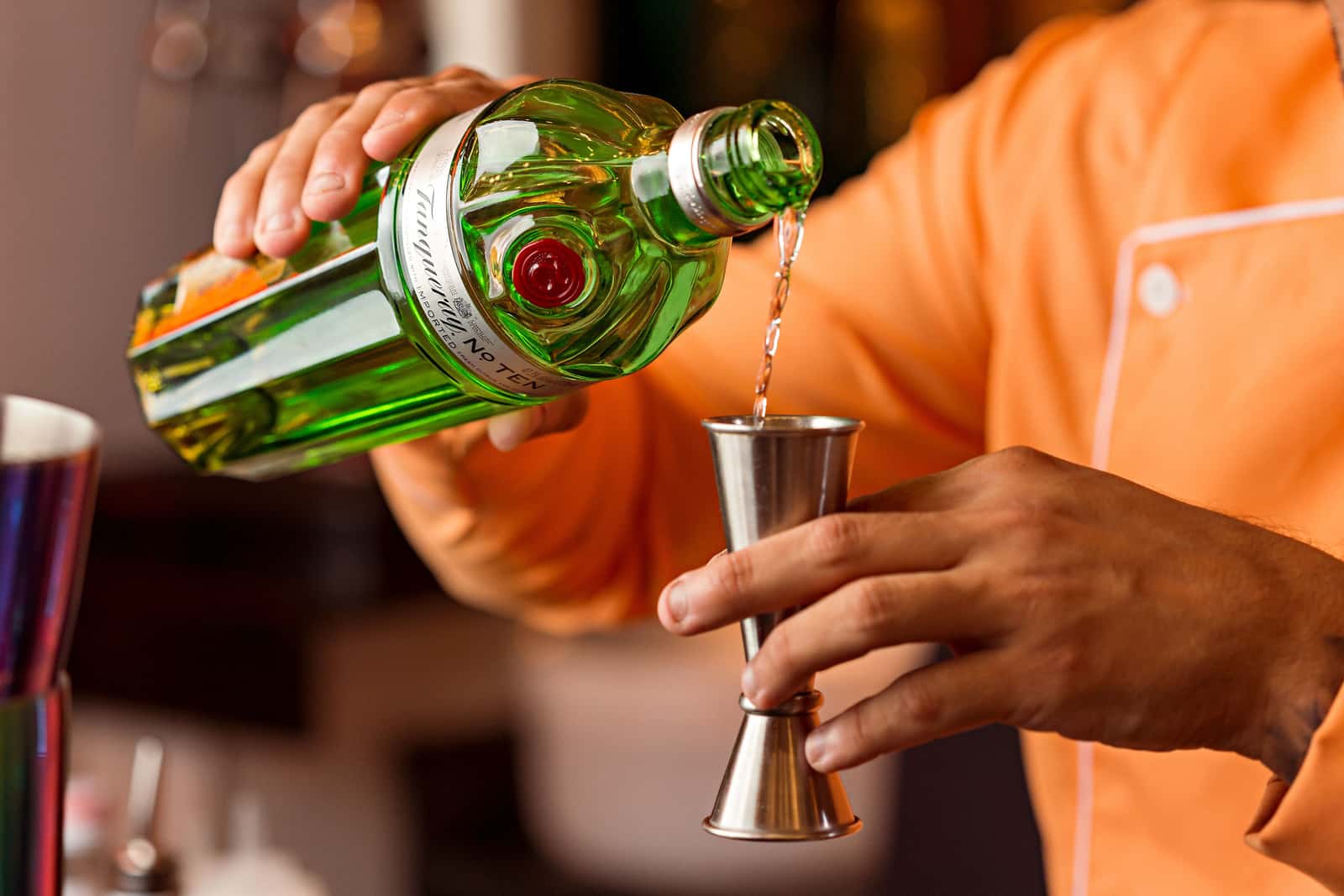
How to measure cocktails without a jigger
Measuring spoons are the answer, and the conversion is two tablespoons to the ounce. Everything else in the drawer is less accurate than it looks.
By Michael W. · Published October 2026
The short answer
Use measuring spoons. One US tablespoon is exactly half a fluid ounce, so two tablespoons make an ounce, three make an ounce and a half, and a half-ounce is one tablespoon - which covers almost every line in almost every cocktail recipe. Teaspoons fill the gaps: three teaspoons to the tablespoon, so a quarter ounce is a teaspoon and a half. A liquid measuring cup with ounce graduations works for anything over an ounce and is useless below it, because the markings are too far apart to read. A shot glass is the substitute most people reach for and the one we would trust least, since no standard defines its volume and unmarked shot glasses in US kitchens run anywhere from about 1.25 to 2 oz. Bottle caps, eyeballing against a glass and counting without a speed pourer are all guesses. And since a decent jigger costs less than one bottle of mid-shelf gin, treat all of this as a solution for tonight rather than a permanent arrangement.
We earn a commission if you buy through the links on this page, at no extra cost to you. It never changes which product we pick. How we are funded.
Quick picks
| # | Product | Best for | Price |
|---|---|---|---|
| 1 | 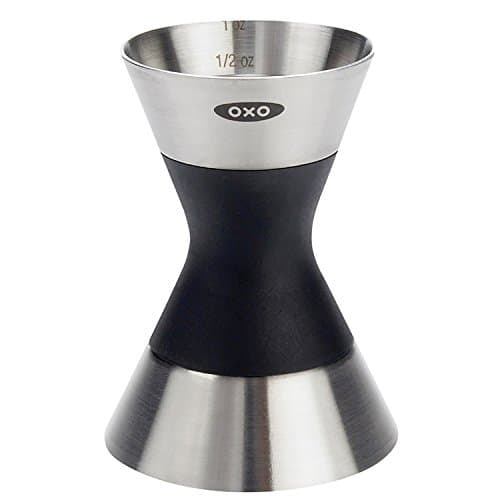 OXO Steel Double Jigger The cheapest end of the problem | Reading the pour from above | $13.95 View on Amazon #ad how we are funded - price as of October 10, 2026 |
| 2 | 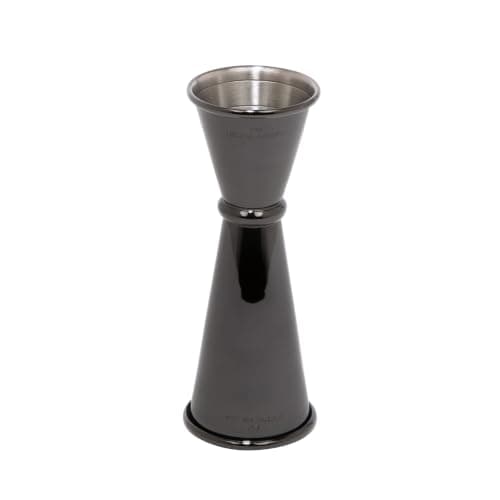 Cocktail Kingdom Japanese Style Jigger, 1oz/2oz Best for accuracy | Accuracy | $32.99 View on Amazon #ad how we are funded - price as of October 10, 2026 |
| 3 | 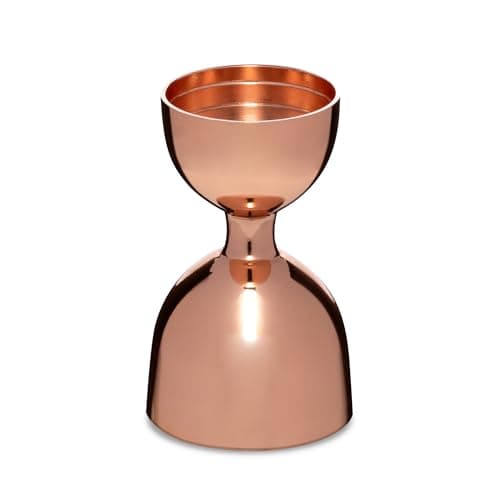 Cocktail Kingdom Leopold Jigger If it lives out on the cart | A jigger that stays put | $44.99 View on Amazon #ad how we are funded - price as of October 10, 2026 |
| 4 | 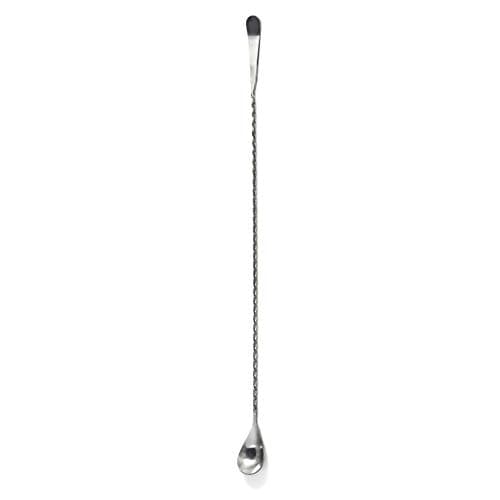 Cocktail Kingdom Hoffman Barspoon The one spoon that is also a measure | Smooth stirring | $36.99 View on Amazon #ad how we are funded - price as of October 10, 2026 |
Scroll the table sideways on a narrow screen. Every price in this table comes from Amazon’s own product data, is refreshed daily, and is stamped with the date it was read - and the button opens the current listing, which is always the final word.
The conversions
Measuring spoons, and the only numbers you need
US measuring spoons are defined volumes, which is exactly what a jigger substitute needs to be. One US tablespoon is 0.5 fl oz, and one US teaspoon is a third of that. That gives you a clean ladder that covers the whole range a cocktail recipe asks for.
| Recipe calls for | In tablespoons | In teaspoons | In ml |
|---|---|---|---|
| 1/4 oz | - | 1 1/2 tsp | About 7.5 ml |
| 1/2 oz | 1 tbsp | 3 tsp | About 15 ml |
| 3/4 oz | 1 1/2 tbsp | 4 1/2 tsp | About 22 ml |
| 1 oz | 2 tbsp | 6 tsp | About 30 ml |
| 1 1/2 oz | 3 tbsp | 9 tsp | About 45 ml |
| 2 oz | 4 tbsp | 12 tsp | About 60 ml |
| 1 barspoon | - | About 1 tsp | About 5 ml |
Two practical notes. Fill the spoon to the brim rather than to a line - a measuring spoon is calibrated full, and a spoon filled to just under the rim is meaningfully short because the top of the spoon is its widest part. And pour from the spoon directly into the tin rather than transferring, because every transfer leaves liquid behind.
Both of those are the same principles that apply to a jigger, for the same reasons. How to use a jigger covers filling to the brim and the lost-volume problem in detail, and the technique transfers directly to spoons.
The substitutes
What else in the kitchen works
A liquid measuring cup with fluid ounce graduations is accurate for anything from about one ounce up, and genuinely bad below it: on a one-cup measure the gap between a quarter ounce and a half ounce is a hairline, and you are reading a meniscus through curved plastic. Use it for the spirit, use spoons for the citrus and the syrup.
A small kitchen scale is the accurate option nobody thinks of, and for syrups and juices it beats every spoon in the drawer. Water, most juices and simple syrup are close enough to 1 g per ml that 30 g is about an ounce - set a tared tin on the scale and pour. It is slower than a jigger and more accurate than one.
A bar spoon's bowl holds roughly a teaspoon, which is useful because a lot of stirred-drink recipes are written in barspoons for exactly that reason. It is a real unit, not an improvisation, and if you own a proper bar spoon you own a small measure already.
A marked glass works if you commit to it: measure an ounce of water into a small glass with a jigger or a measuring spoon once, mark the level with a line of tape on the outside, and you have a dedicated vessel that is accurate for exactly one volume. Bars did a version of this for decades with lined glassware, and the RIEDEL highball with a molded 2 oz fill marker is the modern commercial version of the same idea.
What to avoid
The shot glass problem, and other bad ideas
The shot glass is the substitute almost everyone reaches for and the one we would trust least, because no US federal standard defines a shot. The commonly cited figure is 1.5 fl oz, but unmarked shot glasses sold in the US run from roughly 1.25 to 2 oz, and some are moulded so that the brim volume and the apparent full-to-the-shoulder volume differ by a quarter ounce. If a recipe wants 1.5 oz of rye and your shot glass holds 1.75 oz, you are off by seventeen percent on the dominant ingredient.
If a shot glass is all you have, calibrate it before you use it: pour measuring-spoon ounces into it, mark where an ounce and an ounce and a half land, and from that point on it is a marked glass rather than a guess. That takes a minute once and then the tool is honest.
Bottle caps are a folk measure and a bad one - cap volumes vary by bottler and are nowhere near a standard anything. Eyeballing against the side of the shaker is guessing with extra steps. And counting - the free-pour technique where a one-count equals a known volume through a speed pourer - does not work without the speed pourer, because the flow rate of an open bottle neck is nothing like the flow rate through a spout.
Free pouring by count is a legitimate technique and a different subject from improvising a measure. It needs a calibrated spout, a consistent bottle angle and practice with water before you trust it on spirits. Jigger vs free pouring is the honest argument about whether it belongs on a home bar at all.
The accuracy question
How precise do you actually need to be?
Not all lines in a recipe are equally sensitive, and knowing which is which tells you where to spend your care. Citrus and sweetener are where a quarter ounce is immediately obvious - a daiquiri with an extra quarter ounce of lime is a different and worse drink, and this is the one place we would not improvise if we could avoid it. Base spirit is more forgiving in flavour and less forgiving in strength, since a quarter ounce extra in a 2 oz pour is a noticeably stronger drink by the third one.
Modifiers in small volumes - a quarter ounce of maraschino, two dashes of bitters, a barspoon of absinthe - are where the proportional error gets largest and the consequences get loudest, because being half a teaspoon out on a teaspoon of something assertive is a fifty percent error. These are exactly the lines where measuring spoons beat a shot glass by a wide margin.
Which is the real argument for buying a jigger rather than improvising forever: it is not that spoons are inaccurate, it is that they are slow. Three separate spoons and a wipe between ingredients turns a ninety-second drink into a four-minute one, and the drinks that suffer are the ones you decide not to make. A dual-sided jigger with interior markings replaces the whole drawer. Jigger sizes explained covers which markings matter, and Japanese vs American jigger covers the two profiles.
The picks in full
Every pick, and who each one is for
01 · The cheapest end of the problem
OXO Steel Double Jigger
OXO · Entry tier
#ad how we are funded - price as of October 10, 2026
Angled interior markings you can read while pouring, which removes the bend-down-and-squint step entirely.
Angled interior markings you read from above instead of bending down to squint, a base that is very hard to tip, and a dishwasher rating. The jigger to buy if you just want the measuring question to go away.
The specs that decide it
- Sizes:
- dual-sided, multiple interior marks
- Markings:
- angled for top-down reading
- Material:
- stainless steel
- Dishwasher:
- yes
Who it is for
- Angled markings genuinely work - you stop lowering your head to check a pour
- Wide base is very hard to tip
- Cheap enough to be the jigger you leave out
Where it gives ground
- Bulkier than a Japanese jigger, so it is slower into a tin
- Markings will fade with years of dishwasher cycles
Skip this one if you want the classic tall silhouette on an open bar. This is a working tool, not a display piece.
02 · Best for accuracy
Cocktail Kingdom Japanese Style Jigger, 1oz/2oz
Cocktail Kingdom · Mid tier
#ad how we are funded - price as of October 10, 2026
Tall, narrow and internally marked, which is the combination that makes a half-ounce pour repeatable.
1 oz and 2 oz, tall and narrow with interior lines. The narrow cone turns a given volume into a taller column, so a small error is visible before you pour it - which is the whole point of measuring.
The specs that decide it
- Sizes:
- 1 oz / 2 oz
- Profile:
- tall and narrow
- Markings:
- interior lines for fractional pours
- Material:
- stainless steel, gunmetal black finish
Who it is for
- A narrow cone makes a given volume a taller column, so a small error is visible before you pour it
- Interior lines mean you are not guessing at three quarters of an ounce
- Balanced enough to hold one-handed while the other hand pours
Where it gives ground
- Tall profile tips more easily on a crowded counter
- No handle, so it gets cold and slippery when you work fast
Skip this one if you free-pour by count and are happy with the results. This tool exists to fix a problem you do not have.
03 · If it lives out on the cart
Cocktail Kingdom Leopold Jigger
Cocktail Kingdom · The step up
#ad how we are funded - price as of October 10, 2026
A lower, wider cone with a deco waist - less precise than the tall Japanese profile and much harder to knock over.
A lower, wider cone with a deco waist that actually grips wet fingers, and far more stable set down full than a tall Japanese jigger. Less precise on fractions, and much harder to knock over.
The specs that decide it
- Profile:
- wider, lower center of gravity
- Styling:
- art deco fluting
- Grip:
- waisted middle
- Material:
- stainless steel
Who it is for
- Far more stable set down full than a tall Japanese jigger
- The waist is a real grip, not decoration - it finds your fingers wet
- Reads as an object rather than as equipment on an open cart
Where it gives ground
- Wider bore makes a fractional pour harder to eyeball precisely
- Interior markings are less useful in a shallow cone
Skip this one if your pours drift and you are buying a jigger to fix that. The tall profile does that job better.
04 · The one spoon that is also a measure
Cocktail Kingdom Hoffman Barspoon
Cocktail Kingdom · Mid tier
#ad how we are funded - price as of October 10, 2026
The teardrop counterweight is the whole argument: it carries momentum and irons the jerk out of your stir.
A bar spoon's bowl holds roughly a teaspoon, which is the unit stirred-drink recipes use for syrups and liqueurs. Useful alongside measuring spoons rather than instead of them.
The specs that decide it
- End:
- teardrop counterweight
- Shaft:
- twisted
- Length:
- 43.5 cm (about 17 in)
- Material:
- stainless steel
Who it is for
- Momentum from the weighted end smooths the rotation, which is what makes a quiet stir possible
- Twisted shaft lets the spoon spin between your fingers rather than in your fist
- The teardrop doubles as a passable muddle for a sugar cube
Where it gives ground
- Too long for a short mixing glass and it will fence with the rim
- The weighted end makes it top-heavy if you try to use it as a measuring spoon
Skip this one if your mixing glass is short. Match spoon length to glass height first, brand second.
Questions
Related questions
- How do you measure cocktails without a jigger?
- Use measuring spoons. One US tablespoon is exactly half a fluid ounce, so 1 oz is 2 tablespoons, 1.5 oz is 3 tablespoons, and 0.75 oz is a tablespoon and a half. Teaspoons cover the quarter ounces at three teaspoons per tablespoon. Fill each spoon to the brim and pour straight into the shaker.
- How many tablespoons are in a shot?
- If you mean the common 1.5 fl oz figure, three tablespoons. There is no US legal definition of a shot, though, and unmarked shot glasses run from about 1.25 to 2 oz, so a recipe line expressed in shots is less precise than one expressed in tablespoons.
- Can you use a shot glass instead of a jigger?
- Only after you calibrate it. No standard defines a shot glass's volume and real ones vary from roughly 1.25 to 2 oz, so an uncalibrated shot glass can be out by a quarter ounce or more on the main spirit. Pour measuring-spoon ounces into it once, mark the levels, and from then on it is a marked glass rather than a guess.
- How much is a barspoon in teaspoons?
- Roughly one teaspoon, which is why a lot of stirred-drink recipes are written in barspoons. Bowl volumes vary slightly between spoons, so it is a working unit rather than a calibrated one - good enough for a dash of syrup, not for the citrus in a sour.
- Is a kitchen scale accurate for cocktails?
- Yes, and for juices and syrups it is more accurate than any spoon. Water, most citrus juice and simple syrup are close enough to 1 gram per millilitre that 30 grams is about a fluid ounce. Tare the shaker on the scale and pour. It is slower than a jigger and more precise than one.
- Which ingredients matter most to measure accurately?
- Citrus and sweetener first - a quarter ounce either way is immediately tasteable in a sour. Then small-volume modifiers like maraschino or absinthe, where being half a teaspoon out is a huge proportional error. Base spirit is the most forgiving in flavour, though over-pouring it quietly makes the drink stronger than you intended.
Read next
Related reading
- Jiggers, bar spoons and mixing glasses
Jiggers, spoons and mixing glasses - the half of the bar that decides whether a drink is repeatable.
- How to use a jigger
Fill to the brim, hold it low, pour once - and the measuring order that means you rarely rinse.
- Jigger sizes explained
A full conversion table, what a shot actually measures, and which double-jigger pairing to buy.
- Jigger vs free pouring
Free pouring is a count against a calibrated spout - which is exactly what a home bar does not have.
- Best Japanese jiggers
Why a narrow bore reads more accurately, which size pairing to buy, and the precision-stability trade-off.
- Japanese vs American jigger
Narrow against wide on accuracy, stability and speed - and the middle option that recovers both.