Guide
Jigger sizes explained
The conversion table you want on the counter, plus what a shot actually measures and why the answer depends on where you are.
By Michael W. · Published September 2026
The short answer
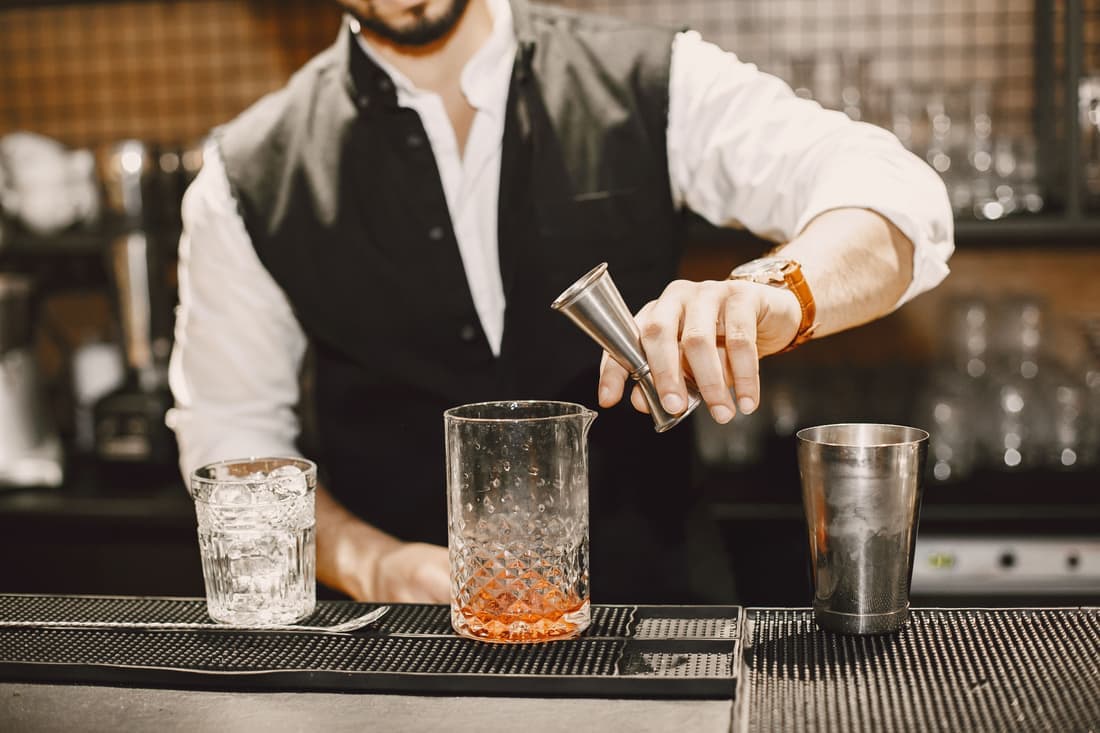
A standard double jigger is 1oz on one end and 2oz on the other, which is about 30ml and 60ml. With interior lines it also gives you a half, three quarters and a quarter ounce, which covers nearly every recipe you will meet. A bar spoon is roughly a teaspoon at about 5ml, and a dash from a bitters bottle is roughly 1ml - though that varies enough by bottle that it is an approximation rather than a measure.
We earn a commission if you buy through the links on this page, at no extra cost to you. It never changes which product we pick. How we are funded.
Quick picks
| # | Product | Best for | Price |
|---|---|---|---|
| 1 |  Cocktail Kingdom Japanese Style Jigger The jigger this table assumes | Accuracy | |
| 2 | OXO Steel Double Jigger If you want to read it from above | Reading the pour from above |
Scroll the table sideways on a narrow screen. Prices are set by the retailer and change, so every price link opens the current listing rather than quoting a number here.
The table
Conversions you actually need
| Measure | Ounces | Milliliters | Where it appears |
|---|---|---|---|
| Dash | about 1/32 oz | about 1 ml | Bitters. Varies by bottle. |
| Bar spoon / teaspoon | about 1/6 oz | about 5 ml | Syrups, absinthe rinse, sugar |
| Quarter ounce | 0.25 oz | about 7.5 ml | Liqueur accents, rich syrup |
| Half ounce | 0.5 oz | about 15 ml | Modifiers, syrups |
| Three quarters | 0.75 oz | about 22 ml | Citrus and syrup in sours |
| One ounce | 1 oz | about 30 ml | Modifiers, secondary spirits |
| Ounce and a half | 1.5 oz | about 44 ml | Common base-spirit pour |
| Two ounces | 2 oz | about 60 ml | Spirit-forward base pour |
| Pony | 1 oz | about 30 ml | Older recipes |
| Jigger (the unit) | 1.5 oz | about 44 ml | Older recipes - confusingly not the tool |
Note the last row. In older American recipe books a 'jigger' is a unit of 1.5oz, not the two-ended tool that shares the name. If a vintage recipe calls for a jigger of rye, it wants an ounce and a half.
The one nobody agrees on
How much is a shot
A shot is not a standardized unit, and this trips people up when following recipes written in a different country.
- United States. Commonly 1.5oz, about 44ml, though there is no federal standard and it varies by state and by bar.
- United Kingdom. Spirits are sold in 25ml or 35ml measures by law, so a 'shot' is one of those.
- Australia. A standard nip is 30ml.
- Continental Europe. Usually 20ml, 40ml or 50ml depending on country.
The practical consequence: if a recipe says 'a shot', find out where it was written before you pour. If you are writing down your own recipes, write ounces or milliliters and never 'shot'.
Choosing
Which pairing to buy
Double jiggers come in fixed pairings and the one you choose decides which recipes involve mental arithmetic.
| Pairing | With lines, also gives you | Verdict |
|---|---|---|
| 1 oz / 2 oz | 0.5, 0.75, 1.5 | The best single purchase |
| 0.75 oz / 1.5 oz | 0.25, 0.5, 1 | Good for classic three-quarter builds |
| 30 ml / 60 ml | 15, 22, 45 | The metric equivalent of the first row |
| 1 oz / 1.5 oz | Little without lines | Awkward - avoid |
Interior lines are what turn a two-number tool into a five-number one, and they are the single specification most worth paying for. A plain unmarked cone in any pairing leaves you estimating everything in between.
Does gear fix this
When a jigger is not the answer
For very small measures - a quarter teaspoon of saline, a few milliliters of a strong syrup - a jigger is the wrong tool. The volume is too small to read in a cone and you will end up with a pool in the bottom that is mostly surface tension. Use a measuring spoon or a dropper.
For very large measures - batching six drinks - a jigger is slow and error compounds. Use a measuring jug and multiply once, rather than measuring the same ingredient six times.
And for dashes of bitters, no measure exists that is worth the effort. Dasher bottles vary and a dash is a calibrated wrist rather than a volume. The honest advice is to use the same bottle consistently and adjust to taste.
For everything between a quarter ounce and two ounces, which is where cocktails actually live, a lined jigger is the right tool. How to use a jigger covers the technique, and best Japanese jiggers covers which one to buy.
The picks in full
Every pick, and who each one is for
01 · The jigger this table assumes
Cocktail Kingdom Japanese Style Jigger
Cocktail Kingdom · Mid tier
Tall, narrow and internally marked, which is the combination that makes a half-ounce pour repeatable.
1oz and 2oz with interior lines, which is the pairing that makes the fractional rows in the table below usable rather than theoretical. A plain unmarked cone gives you two numbers and nothing in between.
The specs that decide it
- Sizes:
- 1 oz / 2 oz
- Profile:
- tall and narrow
- Markings:
- interior lines for fractional pours
- Material:
- stainless steel
Who it is for
- A narrow cone makes a given volume a taller column, so a small error is visible before you pour it
- Interior lines mean you are not guessing at three quarters of an ounce
- Balanced enough to hold one-handed while the other hand pours
Where it gives ground
- Tall profile tips more easily on a crowded counter
- No handle, so it gets cold and slippery when you work fast
Skip this one if you free-pour by count and are happy with the results. This tool exists to fix a problem you do not have.
02 · If you want to read it from above
OXO Steel Double Jigger
OXO · Entry tier
Angled interior markings you can read while pouring, which removes the bend-down-and-squint step entirely.
Angled interior markings you can read while pouring, which is a genuine improvement if you find yourself lowering your head to check a measure. Very hard to tip, and bulkier into a tin.
The specs that decide it
- Sizes:
- dual-sided, multiple interior marks
- Markings:
- angled for top-down reading
- Material:
- stainless steel
- Dishwasher:
- yes
Who it is for
- Angled markings genuinely work - you stop lowering your head to check a pour
- Wide base is very hard to tip
- Cheap enough to be the jigger you leave out
Where it gives ground
- Bulkier than a Japanese jigger, so it is slower into a tin
- Markings will fade with years of dishwasher cycles
Skip this one if you want the classic tall silhouette on an open bar. This is a working tool, not a display piece.
Questions
Related questions
- How many ml is a standard jigger?
- A standard double jigger is 1oz and 2oz, which is about 30ml and 60ml. Confusingly, in older recipes 'a jigger' as a unit means 1.5oz, about 44ml.
- How much is a shot in ounces?
- In the US, commonly 1.5oz, though there is no federal standard. In the UK a spirit measure is 25ml or 35ml by law, and in Australia a nip is 30ml. Check where the recipe was written.
- How much is a bar spoon?
- Roughly a teaspoon, about 5ml or a sixth of an ounce. It is a fine approximation for syrup and a poor way to measure anything you care about.
- How much is a dash of bitters?
- Roughly 1ml, but it varies enough between dasher bottles that it is an approximation rather than a measure. Use the same bottle consistently and adjust to taste.
Read next
Related reading
- Jiggers, bar spoons and mixing glasses
Jiggers, spoons and mixing glasses - the half of the bar that decides whether a drink is repeatable.
- Best Japanese jiggers
Why a narrow bore reads more accurately, which size pairing to buy, and the precision-stability trade-off.
- How to use a jigger
Fill to the brim, hold it low, pour once - and the measuring order that means you rarely rinse.
- Japanese vs American jigger
Narrow against wide on accuracy, stability and speed - and the middle option that recovers both.
- What size cocktail shaker do you need
Why 18 and 28 is the pairing, what a tin really holds with ice, and why two pairs beat one big one.