Guide
How to stir a cocktail
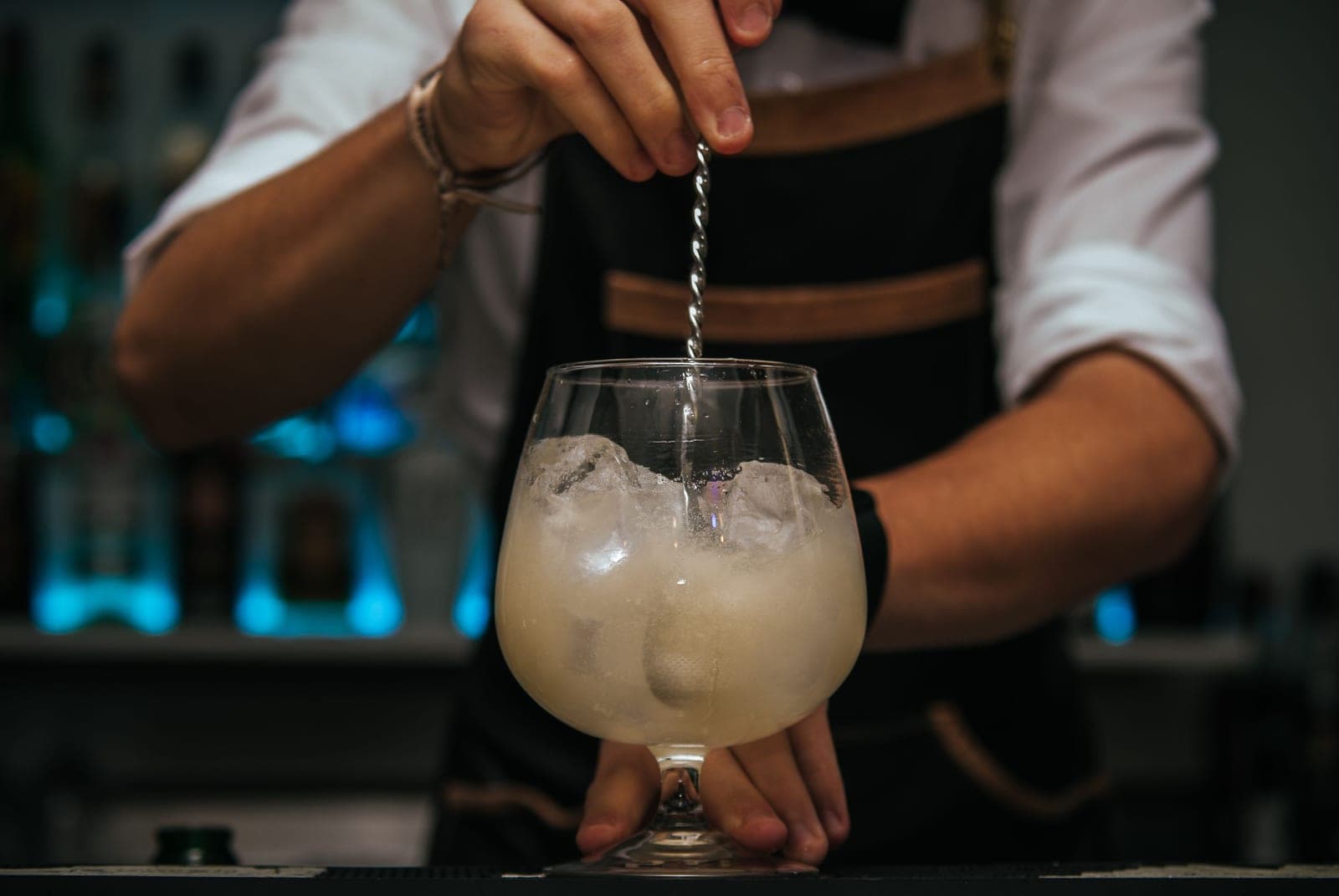
Hold the spoon between two fingers and a thumb, let the shaft rotate in place, and keep the bowl traveling around the wall. Everything else follows from that.
By Michael W. · Published September 2026
The short answer
Fill a chilled mixing glass two thirds to three quarters with large clear ice, add the measured ingredients, and stir for 20 to 30 seconds until the outside of the glass frosts. Hold the spoon lightly between your thumb, index and middle fingers so the twisted shaft rotates in place while the bowl travels around the wall of the glass. A good stir is nearly silent; the rattle you hear in a bad one is ice being interrupted rather than rotating.
We earn a commission if you buy through the links on this page, at no extra cost to you. It never changes which product we pick. How we are funded.
Quick picks
| # | Product | Best for | Price |
|---|---|---|---|
| 1 |  Cocktail Kingdom Hoffman Barspoon The spoon this technique needs | Smooth stirring | |
| 2 |  Cocktail Kingdom Yarai Mixing Glass 500ml The glass | The default mixing glass | |
| 3 |  Cocktail Kingdom Julep Strainer The strainer | Stirred drinks |
Scroll the table sideways on a narrow screen. Prices are set by the retailer and change, so every price link opens the current listing rather than quoting a number here.
The mechanism
Why a quiet stir is a good stir
The noise in a stir is ice being interrupted. If the bowl is churning through the middle of the glass, the pieces collide with each other and with the walls, they chip, and the drink picks up fines that cloud it.
When the bowl travels around the wall instead, the whole ice charge rotates as one column. Nothing collides, nothing chips, and the sound largely disappears. That is the motion you are aiming for and the silence is the feedback.
A molded mixing glass has a faint vertical seam that the ice catches on once per revolution, so a light tick is normal even with good technique. A seamless glass removes it entirely - see best mixing glasses.
Technique
The grip, in detail
This is the part that takes ten minutes to learn and changes everything. Hold the spoon near the top of the shaft between your thumb and the first two fingers, lightly enough that the shaft can turn.
The index and middle fingers do the work. They move the shaft in a small circle, and the spiral lets the shaft rotate within that circle rather than twisting your wrist. The bowl at the far end travels around the wall of the glass. Your wrist barely moves at all.
If your wrist is doing the moving, you are stirring with the spoon as a stick and the twist is decorative. It still works; it is just more effort and noisier. A weighted end helps here because the momentum keeps the circle going between finger movements.
Ice
What ice to stir with
This is the one place in shaking or stirring where good ice genuinely earns its keep. Stirred drinks are chilled slowly by contact, and small cloudy cubes have both more surface area and a lot of trapped air, so they over-dilute and shed fines into a drink whose clarity is part of the point.
Large clear pieces rotate smoothly, melt slowly and leave the drink clear. If you are making clear ice in a mold, the mixing glass is where to spend it - not the shaker, where it gets strained out and the dilution you were resisting is dilution you wanted.
Fill generously. Two thirds to three quarters is right, and under-icing is the standard error: less ice melts faster because each piece is surrounded by more warm liquid. Best clear ice molds covers how to produce it.
Does gear fix this
When the answer is technique and when it is not
If your stirred drinks come out cloudy, that is ice and technique, not equipment. Small cubes plus a churning motion produces fines, and no glass fixes either.
If your stirred drinks come out weak, that is over-stirring or under-icing. Thirty seconds is a ceiling, not a target, and a half-filled glass dilutes faster than a full one.
Where gear does help: a heavy glass stops the vessel traveling across the counter, a spoon of the right length stops your knuckles being in the drink, and a julep strainer makes the pour genuinely easier. Those are real improvements and none of them is expensive. Mixing glass vs shaker covers which drinks belong here in the first place.
The picks in full
Every pick, and who each one is for
01 · The spoon this technique needs
Cocktail Kingdom Hoffman Barspoon
Cocktail Kingdom · Mid tier
The teardrop counterweight is the whole argument: it carries momentum and irons the jerk out of your stir.
A well-cut twisted shaft is what lets the spoon rotate between your fingers, and the teardrop counterweight carries momentum through each revolution. With an unweighted straight-shafted spoon the motion described above is much harder to sustain.
The specs that decide it
- End:
- teardrop counterweight
- Shaft:
- twisted
- Lengths:
- multiple, choose to match your mixing glass
- Material:
- stainless steel
Who it is for
- Momentum from the weighted end smooths the rotation, which is what makes a quiet stir possible
- Twisted shaft lets the spoon spin between your fingers rather than in your fist
- The teardrop doubles as a passable muddle for a sugar cube
Where it gives ground
- Too long for a short mixing glass and it will fence with the rim
- The weighted end makes it top-heavy if you try to use it as a measuring spoon
Skip this one if your mixing glass is short. Match spoon length to glass height first, brand second.
02 · The glass
Cocktail Kingdom Yarai Mixing Glass 500ml
Cocktail Kingdom · Mid tier
The industry workhorse: heavy, cut, and sized for one or two drinks without a wall of leftover dilution.
Heavy enough to stay still while you stir and straight-walled enough that the ice rotates as a column rather than tumbling. A pint glass works and is worse at both.
The specs that decide it
- Capacity:
- 500 ml (about 17 oz)
- Capacity in drinks:
- 1 to 2
- Pattern:
- Yarai cut
- Base:
- heavy, weighted
Who it is for
- Mass is the point - a heavy glass does not travel across the counter while you stir
- The cut gives grip that a smooth beaker does not
- Spout pours clean, which sounds trivial until you use one that does not
Where it gives ground
- Glass, on a counter, near ice - it is a breakable in a wet environment
- 500 ml gets tight with two drinks and a full ice charge
Skip this one if you regularly build three or four stirred drinks at once. Step up to the 675 ml seamless.
03 · The strainer
Cocktail Kingdom Julep Strainer
Cocktail Kingdom · Entry tier
The right strainer for a mixing glass, and the one most home bars skip and then wonder why stirring feels awkward.
Seats inside the glass so the pour is controlled by wrist angle, which is faster and far less awkward than balancing a Hawthorne on the rim of a mixing glass.
The specs that decide it
- Type:
- julep
- Fit:
- seats inside a mixing glass at an angle
- Perforation:
- large holes - no spring
- Material:
- stainless steel
Who it is for
- Sits inside the glass instead of on the rim, so the pour is controlled by wrist angle
- Nothing to clean but a bowl - no spring to trap citrus
- Costs very little and lasts indefinitely
Where it gives ground
- Useless for shaken citrus drinks - the holes are far too large
- Fit varies with glass diameter, so check it against your mixing glass
Skip this one if you shake nine drinks out of ten. Buy a Hawthorne first and come back to this.
Questions
Related questions
- How long should you stir a cocktail?
- 20 to 30 seconds, until the outside of the glass frosts. Stirring is gentler than shaking so it takes longer to reach the same temperature and dilution.
- Why is my stirred cocktail cloudy?
- Small cubes and a churning motion. Both produce ice fines that cloud the drink. Use large clear pieces and keep the bowl of the spoon traveling around the wall rather than through the middle.
- How do you hold a bar spoon?
- Lightly, near the top, between thumb, index and middle finger, so the twisted shaft can rotate in place. If it is in your fist, the twist is doing nothing.
- Should the mixing glass be chilled first?
- Yes. Unlike a shaker tin, a mixing glass has real thermal mass, and a room-temperature one spends the first part of your stir cooling itself rather than the drink.
Read next
Related reading
- Jiggers, bar spoons and mixing glasses
Jiggers, spoons and mixing glasses - the half of the bar that decides whether a drink is repeatable.
- Best mixing glasses
Capacity, mass, seam and spout compared - and why a pint glass is worse at every part of the job.
- Best bar spoons
Length, twist and end weight compared - and why measuring your glass matters more than picking a brand.
- Mixing glass vs shaker
Which drinks to stir, which to shake, and what each method actually does to texture and clarity.
- Best clear ice molds
Insulated molds compared on yield, piece size and the freezer footprint they actually demand.