Guide
How much juice is in a lime?
About an ounce, which is almost exactly one cocktail. Everything else on this page is about why your limes sometimes give you less.
By Michael W. · Published October 2026
The short answer
A typical supermarket lime gives about 1 fluid ounce of strained juice - roughly 2 tablespoons, or 30 ml. That figure comes from two USDA numbers: a raw lime of about 2 inches across weighs around 67 grams, and USDA's food yields handbook puts juiced-and-strained limes at an average yield of about 47% by weight, which works out at roughly 31 grams of juice. Since most sour cocktails call for 0.75 to 1 oz of lime, the planning rule is simple: one lime per drink, plus one spare. Key limes are a different fruit and a different number - they are much smaller, so budget three or four of them per ounce. Yield swings a long way with ripeness, temperature and your tool: a hard, cold, underripe lime squeezed by hand can give half what a ripe room-temperature one gives through a geared press. If you are consistently getting less than an ounce, the fruit or the squeezer is the problem, not the lime.
We earn a commission if you buy through the links on this page, at no extra cost to you. It never changes which product we pick. How we are funded.
Quick picks
| # | Product | Best for | Price |
|---|---|---|---|
| 1 | 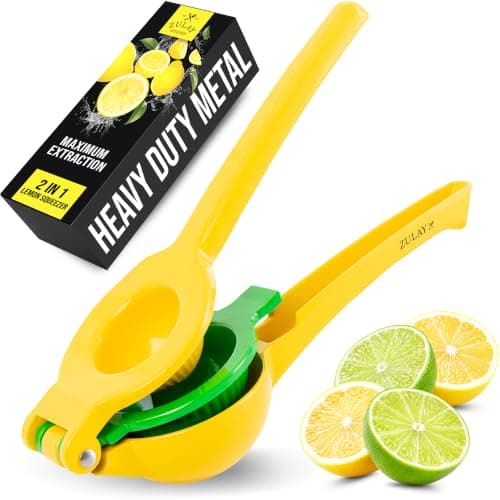 Zulay Kitchen Metal 2-in-1 Lemon Lime Squeezer The sensible default | Limes and lemons from one tool | $14.39 #ad how we are funded - price as of October 10, 2026 |
| 2 | 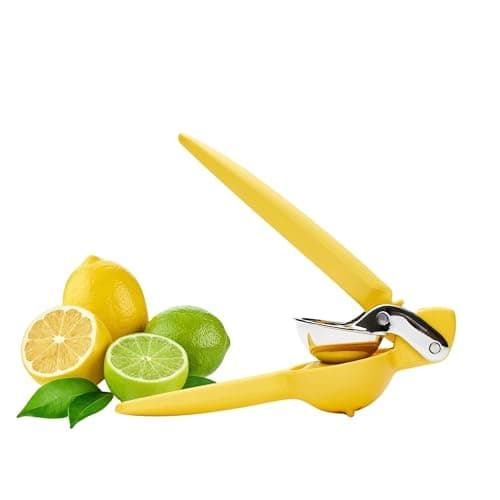 Chef'n FreshForce Citrus Juicer Most juice per squeeze | The most juice per squeeze | $17.66 #ad how we are funded - price as of October 10, 2026 |
| 3 | 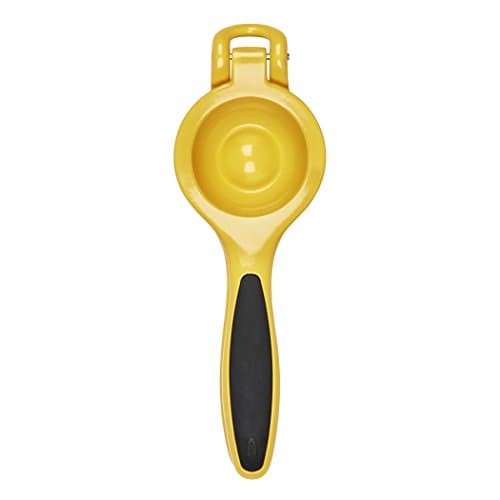 OXO Good Grips Citrus Squeezer Most comfortable, and dishwasher safe | Comfort, and a dishwasher | $21.95 View on Amazon #ad how we are funded - price as of October 10, 2026 |
| 4 | 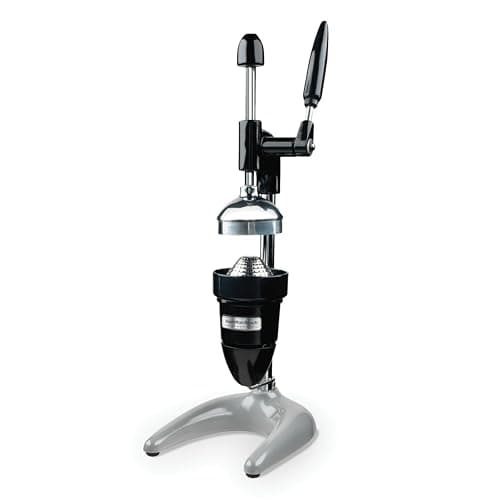 Hamilton Beach Commercial 932 Manual Citrus Juicer If you are juicing for a party | Juicing for a party in one pass | $266.37 #ad how we are funded - price as of October 10, 2026 |
Scroll the table sideways on a narrow screen. Every price in this table comes from Amazon’s own product data, is refreshed daily, and is stamped with the date it was read - and the button opens the current listing, which is always the final word.
The number
About 1 oz, and where that figure comes from
The honest answer to how much juice is in a lime is a range with a reliable centre, and the centre is about one fluid ounce. Two published USDA figures get you there. USDA's reference data puts a raw lime of roughly 1.75 to 2 inches in diameter at about 58 to 76 grams, with 67 grams as the common reference weight. USDA's Agriculture Handbook No. 102 on food yields puts limes, juiced and strained, at an average yield of about 47% of the whole fruit by weight.
Multiply those and a 67 gram lime gives about 31 grams of strained juice. Lime juice is close enough to water in density that 31 grams is about 31 ml, which is a touch over one US fluid ounce - and in kitchen terms, 2 tablespoons.
| Fruit | Typical juice per fruit | In tablespoons | Fruit per 1 oz |
|---|---|---|---|
| Persian or Tahiti lime (the supermarket default) | About 1 fl oz (30 ml) | About 2 tbsp | 1 |
| Small or underripe lime | Around 0.5 to 0.75 fl oz | 1 to 1.5 tbsp | 1.5 to 2 |
| Large, ripe, room-temperature lime | Up to about 1.5 fl oz | Up to 3 tbsp | Less than 1 |
| Key lime | Well under 0.5 fl oz | Under 1 tbsp | 3 to 4 |
That bottom row is the one that catches people out. Key limes are a genuinely different and much smaller fruit, and a recipe written for Persian limes will need three or four key limes to hit the same ounce. They also taste different - more floral, more bitter - so swapping them in changes the drink as well as the arithmetic.
Planning
How many limes to buy for a round
Most lime-forward cocktails use 0.75 to 1 oz of juice. A daiquiri, a gimlet and a margarita all sit in that band, which makes the planning rule unusually clean: one lime per drink, plus one spare for the round. Buy to that and you will not be standing at the counter mid-service with half a drink and no fruit.
| Drinks | Juice needed | Limes to buy |
|---|---|---|
| 2 daiquiris at 0.75 oz | 1.5 oz | 3 |
| 4 margaritas at 1 oz | 4 oz | 5 |
| 6 mojitos at 0.75 oz | 4.5 oz | 6 |
| 8 margaritas at 1 oz | 8 oz | 9 or 10 |
| A batch - 16 oz of juice | 16 oz | 18 to 20 |
The spare is not padding. It is there because the yield range is real: one hard pale lime in a bag of six can give you half what the others do, and you only find out at the squeezer. Over-buying by one lime per round costs very little, and a wedge or a twist always finds a use.
Above about 8 oz of juice the tool changes the answer more than the fruit count does. A handheld squeezer is faster than a lever press for a handful of fruit and slower for a dozen, because the lever press empties a half in one stroke while your hand does not. Best citrus juicers for cocktails covers where that crossover falls.
Getting more out
Four things that change your yield
Temperature first, because it is the easiest win and the one nobody does. A lime straight from the fridge is firmer and its membranes are less willing to release juice than the same lime at room temperature. Take the limes out twenty minutes before you need them, or hold them under warm water for a minute. A few seconds in a microwave does the same job faster, at the cost of slightly cooked aromatics.
Second, roll it. Pressing a lime firmly against the counter under your palm before you cut it ruptures the internal membranes, which means more of the juice is already free when the squeezer closes. It takes five seconds per fruit and it is visible in the glass.
Third, ripeness. A lime with a little give, a thin skin and a yellowish cast at the blossom end is further along than a rock-hard dark green one, and it holds noticeably more juice. The deep-green unblemished limes that look best in the bowl are frequently the least generous.
Fourth, the tool, and this is where the gap is biggest. Squeezing by hand into a shaker leaves a lot behind and puts seeds and pith into the drink. A plain squeezer inverts the half and gets most of it. A geared press multiplies your grip - the Chef'n FreshForce claims up to 20% more juice than a standard handheld - and a lever press with up to 2,000 lb of force leaves a visibly drier husk. On ten limes that difference is an extra drink or two.
Juice it last, not first. Fresh lime juice is at its best within a couple of hours and falls off noticeably over a day - the bright top note goes first and a dull, slightly bitter edge arrives. Squeeze into the shaker as you build the drink rather than prepping a jug in the morning.
Measuring it
Why you should still jigger the juice
Knowing that one lime is about an ounce is a shopping tool, not a measuring tool. A sour is a balance between spirit, citrus and sugar, and a quarter-ounce swing in the citrus is the difference between a daiquiri that sings and one that puckers. Squeezing a lime straight into the tin and calling it an ounce is how a drink you made perfectly on Friday tastes wrong on Saturday.
So squeeze into a jigger, not into the shaker. It costs nothing in time, it tells you immediately whether that particular lime gave you 0.6 oz or 1.2 oz, and it lets you top up from the next fruit rather than discovering the imbalance after the shake. How to use a jigger covers the technique, and jigger sizes explained covers which markings you actually need.
The last step is straining. Even a squeezer with a perforated base lets some pulp through, and pulp in a shaken drink reads as texture rather than as flavour. A fine mesh strainer on the pour catches it. When to double strain a cocktail covers when that is worth doing and when it is fussiness, and best cocktail shakers for margaritas is the tin side of a lime-heavy bar.
The picks in full
Every pick, and who each one is for
01 · The sensible default
Zulay Kitchen Metal 2-in-1 Lemon Lime Squeezer
Zulay Kitchen · Entry tier
#ad how we are funded - price as of October 10, 2026
Two nested bowls in one coated-aluminum body, so the same squeezer takes a lime, a lemon or a small orange - the sensible default for a home bar.
Two nested bowls in one coated-aluminium body, so the same tool takes a lime, a lemon or a small orange - which is the real answer to the one-size problem. A perforated base holds back seeds and pulp.
The specs that decide it
- Material:
- aluminum with a food-grade coating
- Bowls:
- two nested sizes
- Size:
- 8.7 in by 3 in by 2 in, about 0.75 lb
- Dishwasher:
- dishwasher safe per the maker
- Filter:
- perforated base holds back seeds and pulp
Who it is for
- The nested bowl is a real answer to the one-size problem, not a marketing feature
- Light enough to live in a drawer rather than on the counter
- The cheapest meaningful upgrade over squeezing by hand into a shaker
Where it gives ground
- Coated aluminum chips at the bowl edge with hard use, and the coating is what holds off discoloration
- Less mechanical advantage than a geared press, so a bag of limes is still work
Skip this one if you make drinks for a crowd. Volume is where a geared press or a lever press pays for itself.
02 · Most juice per squeeze
Chef'n FreshForce Citrus Juicer
Chef'n · Mid tier
#ad how we are funded - price as of October 10, 2026
A dual-gear handheld press that multiplies your hand pressure instead of relying on it - the handheld to buy if you build sours by the round.
A dual-gear press that multiplies your hand pressure rather than relying on it, with a maker claim of up to 20% more juice than a standard handheld. The one that shows its value on the tenth lime, not the first.
The specs that decide it
- Mechanism:
- patented dual-gear press
- Materials:
- die-cast zinc, nylon and stainless steel
- Size:
- about 10 in long
- Versions:
- separate lemon, lime and orange models
- Maker claim:
- up to 20% more juice than a standard handheld
Who it is for
- The gear mechanism does work your grip would otherwise do, which shows up on the tenth lime
- Inverts the fruit so pith and seed stay behind rather than riding into the shaker
- Metal in the stress path rather than plastic, which is where cheap squeezers fail
Where it gives ground
- Sized per fruit - the lime model will not take a large lemon, so a mixed bar wants two
- More moving parts in the hinge means more places for pulp to dry if you leave it in the sink
Skip this one if you juice two limes a week. A plain squeezer is less to store and less to clean.
03 · Most comfortable, and dishwasher safe
OXO Good Grips Citrus Squeezer
OXO · Entry tier
#ad how we are funded - price as of October 10, 2026
Die-cast aluminum with cushioned handles that spread the load across your palm, and the pick here you can put in a dishwasher without thinking about it.
Die-cast aluminium with cushioned handles that spread the load across your palm, and a dishwasher rating so citrus acid never sits on it overnight. One bowl size, which is its limitation.
The specs that decide it
- Material:
- die-cast aluminum
- Length:
- about 10 1/2 in
- Dishwasher:
- dishwasher safe
- Fits:
- lemon and lime halves
Who it is for
- The soft handles are the feature: pressure lands on your palm rather than on two metal edges
- Dishwasher safe, so citrus acid never sits on it overnight
- One-piece casting with nothing to work loose
Where it gives ground
- One bowl size, so a small lime rattles and a large lemon has to be forced
- Aluminum dulls and can discolor where acid pools, which is cosmetic but visible
Skip this one if you want one tool for limes and lemons both. A nested two-size bowl handles the range better.
04 · If you are juicing for a party
Hamilton Beach Commercial 932 Manual Citrus Juicer
Hamilton Beach Commercial · The one worth stretching for
#ad how we are funded - price as of October 10, 2026
The cast lever press bars actually use: up to 2,000 lb of force through an arm, no electricity, and a finish built for citrus acid.
A cast lever press with up to 2,000 lb of force through the arm, NSF listed, taking limes through grapefruit. A half empties in one stroke, which is what turns a litre of lime juice from a chore into a job.
The specs that decide it
- Force:
- up to 2,000 lb through the lever arm
- Dimensions:
- 19.5 in H by 9 in W by 7 in D
- Weight:
- about 13.2 lb
- Finish:
- acid-resistant enamel over die-cast aluminum
- Fruit range:
- limes through grapefruit
- Certification:
- NSF listed
Who it is for
- A lever press empties a half in one stroke, so prepping a liter of lime juice stops being a chore
- Nothing to plug in and nothing to burn out - this design has been in production for decades
- Removable cone and funnel, so the parts that touch juice come out to wash
Where it gives ground
- 19.5 inches tall and about 13 lb: this is a counter appliance that never gets put away
- Vast overkill for two drinks, and the first thing you will resent in a small kitchen
Skip this one if you do not batch. Below about a dozen fruit at a time a handheld is faster door to door.
Questions
Related questions
- How much juice is in one lime?
- About 1 fluid ounce - roughly 2 tablespoons or 30 ml - from a typical Persian lime. That follows from USDA figures: a lime of about 2 inches across weighs around 67 grams, and juiced-and-strained limes yield about 47% of the fruit by weight, which is about 31 grams of juice.
- How many limes do you need for 1 cup of lime juice?
- Around eight, and buy nine or ten. One cup is 8 fl oz and a typical lime gives about an ounce, but yields vary enough across a single bag that planning without a spare or two leaves you short.
- How many limes for a margarita?
- One. A standard margarita uses about 1 oz of lime juice, which is roughly what one Persian lime gives. For a round of four, buy five limes - the spare covers the one hard lime in the bag that only gives you half.
- How much juice is in a key lime?
- Well under half an ounce - usually under a tablespoon - because a key lime is a much smaller fruit than the Persian limes sold as standard. Budget three or four key limes per ounce, and remember they also taste more floral and more bitter, so the substitution changes the drink.
- Why do my limes give so little juice?
- Usually one of four things: they are cold from the fridge, they are underripe and rock hard, you have not rolled them under your palm before cutting, or you are squeezing by hand rather than using a press. Fixing all four can roughly double what you get out of the same fruit.
- Should you measure lime juice or just squeeze it into the drink?
- Measure it. One lime averages an ounce but any individual lime can give 0.6 oz or 1.2 oz, and a quarter-ounce swing in citrus is the difference between a balanced sour and a sharp one. Squeeze into a jigger so you can top up from the next fruit before anything is shaken.
- How long does fresh lime juice last?
- Use it within a couple of hours for a cocktail. Lime juice loses its bright top note fast and develops a dull bitter edge within a day, which is why bars squeeze to order or in small batches. Juice as you build the drink rather than prepping a jug in advance.
Sources
Read next
Related reading
- Shakers and strainers
Weighted tins, cobblers and strainers, ranked on the thing that actually matters: whether the seal behaves.
- Best citrus juicers for cocktails
The cheapest real upgrade on the bar: geared press, nested squeezer or lever press, and which one your volume calls for.
- Best cocktail shakers for margaritas
Two drinks a shake, pulp through a fine mesh, and the citrus press that matters more than any tin.
- When to double strain a cocktail
Shaken, with something in it, served up - the three-part test for when a fine mesh earns its place.
- How to use a jigger
Fill to the brim, hold it low, pour once - and the measuring order that means you rarely rinse.
- Jigger sizes explained
A full conversion table, what a shot actually measures, and which double-jigger pairing to buy.