Roundup
The most durable bar carts and cabinets
A working bar cart carries 40 to 55 lb of glass and liquid. Most of them publish a 40 lb shelf rating, or no rating at all. Here is which pieces hold up, and the number to look for.
By Michael W. · Published November 2026
The short answer
If the piece is going to be loaded and rolled every week, the honest answer is a commercial utility cart rather than a bar cart: the Seville Classics UltraDurable is NSF listed with a published 500 lb distributed rating across three steel shelves, which is roughly ten times what a decorative cart states, and nothing on it can swell, spot or craze. If it has to look like furniture, the SEI Furniture Holly & Martin Zephs is the sturdiest construction we could verify - powder-coated iron tubing and 5 mm tempered glass, 40 inches wide, with about 40 lb a shelf from its assembly documentation. For an enclosed piece the Crosley Landon cabinet publishes a 100 lb top rating and puts doors between the collection and sunlight, which is the single biggest reason a cabinet outlives a cart. The Nathan James Carter is the best conventional cart here but publishes no load rating at all, which is the category norm rather than a mark against it specifically. The MAHANCRIS three-tier is the one to avoid for this job: it is the right cart for a narrow gap and the wrong cart for a heavy load, and its own listing says not to put bottles on the top tier. Read the next section before you buy any of them, because the arithmetic is the part that decides this.
We earn a commission if you buy through the links on this page, at no extra cost to you. It never changes which product we pick. How we are funded.
Quick picks
| # | Product | Best for | Price |
|---|---|---|---|
| 1 | 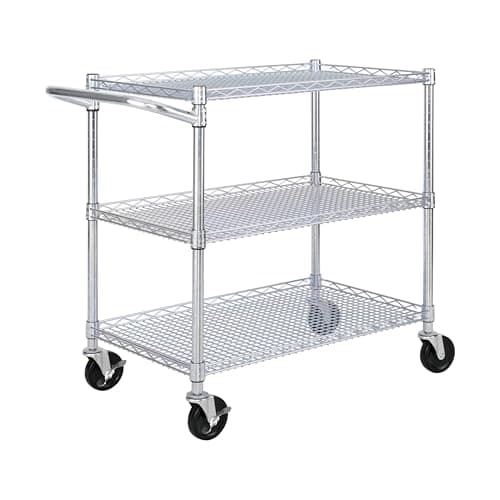 Seville Classics UltraDurable NSF Commercial Rolling Utility Cart, 36 in W x 18 in D Most durable overall | A bar that gets used hard | $99.98 View on Amazon #ad how we are funded - price as of November 3, 2026 |
| 2 | 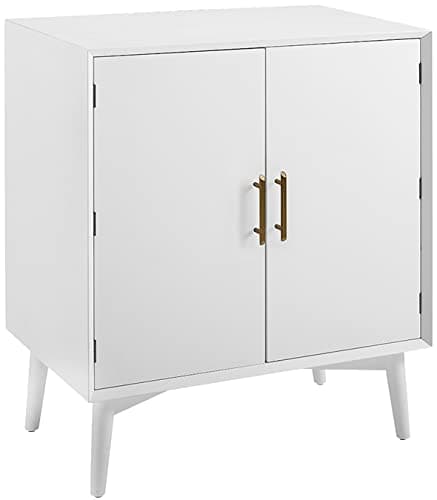 Crosley Landon Bar Cabinet Most durable enclosed piece | Closing the bar | $257.83 View on Amazon #ad how we are funded - price as of November 3, 2026 |
| 3 | 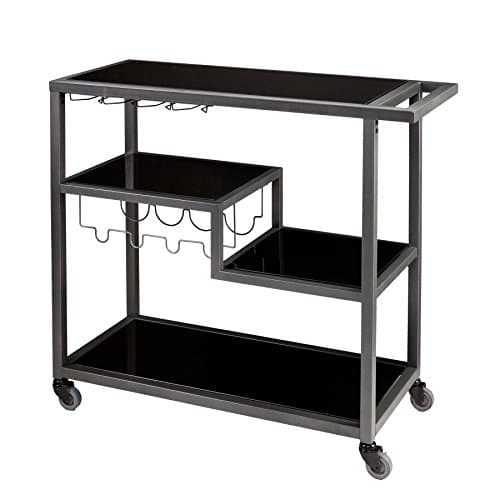 SEI Furniture Holly & Martin Zephs Bar Cart Most durable cart that still looks like one | A cart that has to look like furniture | $140.82 View on Amazon #ad how we are funded - price as of November 3, 2026 |
| 4 |  Nathan James Carter Rolling Bar Cart Best conventional cart, with a caveat | Most home bars | |
| 5 | 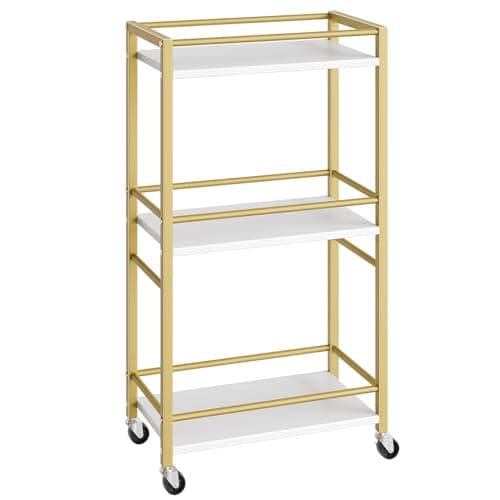 MAHANCRIS 3-Tier Rolling Bar Cart The one to avoid for heavy use | Narrow gaps | $45.99 #ad how we are funded - price as of November 3, 2026 |
Scroll the table sideways on a narrow screen. Every price in this table comes from Amazon’s own product data, is refreshed daily, and is stamped with the date it was read - and the button opens the current listing, which is always the final word.
The real load
What a working bar cart actually weighs
Nobody shops for a bar cart with a scale, which is why this category gets away with the ratings it publishes. So before the picks, the arithmetic - because once you have the number, most of the carts sold as bar carts disqualify themselves.
Start with a bottle. A 750 ml spirit at 40% ABV holds roughly 700 g of liquid, because a 40% ethanol and water mix is a little less dense than water. The empty bottle is the bigger variable: a plain flint bottle runs around 500 g, and a heavy-based bottle with a punt and a thick shoulder can be 900 g or more. So a full bottle is somewhere between about 2.6 and 3.5 lb, and a shelf of spirits is heavier per bottle than a shelf of wine, not lighter.
Now load the cart the way you actually use it. Ten open bottles is 26 to 35 lb. Eight tumblers or stems at 300 to 400 g each adds another 5 to 7 lb. A 2 liter ice bucket packed with ice is about 3 lb of ice plus the bucket, so call it 4 to 5 lb full. Add a shaker set, a jigger, a strainer and a mixing glass and you are at 6 to 8 lb of tools. A genuinely working cart is carrying 40 to 55 lb, and almost all of it wants to be on one or two shelves rather than spread evenly over three.
Those are our figures, derived from published bottle and glassware weights - not a manufacturer specification, and not something we put on a scale. They are deliberately a range. The point is the order of magnitude: a working home bar cart is a 40 to 55 lb load, which is at or over the published shelf rating of most carts sold for the job.
Hold that against what the category publishes. The SEI Zephs - a solidly built iron and tempered-glass cart - has about 40 lb a shelf in its assembly documentation. The MAHANCRIS tells you not to put bottles on the top tier. The Nathan James Carter publishes nothing at all. The Seville Classics commercial cart publishes 500 lb distributed. That spread is not a difference of degree; it is a difference in what the object is for.
How we picked these
The criteria, in the order they matter
Durability in this category is four things, and they are not equally important. We ranked on them in this order, and we gave no credit at all for finish, colorway or how a cart photographs.
- A published load rating. Not a reassuring adjective - a number, from the manufacturer or from the assembly documentation. A piece that publishes a rating has been designed against one; a piece that publishes nothing has been designed against a price.
- Frame construction. Welded or bolted tube beats folded sheet metal, and both beat a frame whose rigidity depends on the shelves being in place. The test is whether the frame racks - twists out of square - when you push the top corner sideways with the casters locked.
- Shelf material. Steel does not care. Tempered glass chips but does not swell, and at 5 mm it tolerates a bottle base put down hard. Annealed glass cracks. MDF with a printed laminate swells permanently anywhere a drink sits, and that is the single most common way a cart stops looking acceptable.
- Casters and the load path. A heavy cart needs casters sized for the load and a frame that puts the weight through the legs rather than through a shelf bracket. Stem casters pressed into thin tube are the first thing to fail on an overloaded cart.
| Piece | Published load rating | Frame | Shelf material | Honest limitation |
|---|---|---|---|---|
| Seville Classics UltraDurable NSF cart | 500 lb distributed (manufacturer) | Commercial steel, push handle | Steel | Looks like a restaurant cart; 36 x 18 in footprint |
| Crosley Landon bar cabinet | 100 lb top (manufacturer) | Enclosed carcass | Wood-based carcass shelves | Heavy furniture - you position it once |
| SEI Furniture Holly & Martin Zephs | About 40 lb per shelf (assembly sheet, sibling SKU) | Powder-coated iron tubing | 5 mm tempered glass | No rating published for this exact SKU |
| Nathan James Carter | None published | Metal frame, railed top | Glass | No number to design your load against |
| MAHANCRIS 3-tier | None published; listing advises no bottles on the top tier | Light metal | Metal | Explicitly not a heavy-load cart |
The second column is the whole page. Two of these five publish a real number, one publishes a number for a near-identical model, and two publish nothing. If you take one habit from this, take the habit of looking for that number before you look at the finish. Bar cart dimensions guide has the sizes and clearances, and bar furniture buying guide sorts the category into its four pieces before you choose between them.
Where carts fail
The four failure modes, in the order you will meet them
Carts rarely collapse. They degrade in four specific ways, and knowing the order makes the specifications above read differently.
1. The shelf surface goes first
On an MDF-and-laminate shelf the failure is water. Condensation off a cold glass and the drip off a bottle neck both sit at the laminate seam, the board underneath wicks it, and it swells. Swelling is permanent - it does not dry back flat - and once the laminate lifts at an edge the shelf is cosmetically finished. This is why the steel and tempered-glass options here beat better-looking carts, and it is why a coaster habit is a durability measure rather than an aesthetic one. Best coasters for sweaty drinks ranks materials on exactly that mechanism.
2. The frame goes out of square
A cart whose rigidity depends on the shelves being bolted in will slowly rack if it is rolled loaded, because the load tries to twist the frame every time a caster meets a threshold. You notice it as a wobble, then as shelves that no longer sit flush. Tube frames, especially welded ones, resist this; frames made of folded sheet with a few bolts do not. Push the top corner sideways with the casters locked: if the whole thing leans and springs back, it is racking.
3. The casters seize or shear
Stem casters pressed into thin tube are the standard economy. Loaded over the rating and rolled on carpet, the stem works loose in the tube and the wheel starts to cant; on a hard floor grit packs the bearing and the wheel stops turning, which is worse, because then you are dragging. Lockable casters help for a second reason - a locked cart cannot be shoved, so the frame stops taking the twist.
4. The glass chips at the clamp
Glass shelves are usually held by rubber-lined clamps or sit in a channel. The failure point is the contact edge, where a shelf under load concentrates stress on a small area. Tempered glass chips there rather than cracking across, so it is a cosmetic problem rather than a safety one - which is exactly why 5 mm tempered matters more than thickness alone. Annealed glass in the same position can fail across the sheet.
Note what is not on that list: finish wear. Powder coat on steel or iron is genuinely durable indoors, and a scratch in it is a scratch rather than the start of a failure. Outdoors is a different question entirely, and the answer is still no - outdoor bar cart accessories explains why no cart in this class should live outside through a season.
Cabinets
Why an enclosed piece usually outlasts an open one
Everything above is about carts, because carts are what people shop for. But if the question is which piece holds up to everyday heavy use, the enclosed cabinet wins on three structural grounds and one that has nothing to do with structure.
Structurally, a cabinet carries its load through a carcass rather than through four shelf brackets, it does not move so it never takes the twisting load that racks a cart frame, and it has no casters to seize. The Crosley Landon publishes a 100 lb top rating, and that top is a working surface rather than a storage shelf - the bottles live on the two deep door shelves and the two interior shelves, where the carcass takes the weight.
The non-structural reason is the one that actually preserves what you own. Doors keep dust out of upturned stems and, more importantly, keep ultraviolet light off the bottles. Light degrades open spirits over months and bleaches labels much faster than that, so an open cart in a bright room is slowly spoiling its own contents while the frame stays perfectly sound. If your collection is the expensive part, a cabinet protects it in a way no cart can. Bar cart vs bar cabinet is the full comparison, and best home bar cabinets ranks the enclosed options.
The trade is real and it is not only about display. A cabinet is heavy, it needs a wall, it is a one-position piece of furniture, and if it is wrong for the room you are not fixing that with casters. A cart is a compromise you can move. Which is the better buy depends on whether the thing you are short of is a surface or storage, which is the question bar furniture buying guide exists to answer.
The honest part
What nobody in this category publishes, and what to do about it
We have not load-tested any of these pieces and we are not going to imply that we have. Every rating on this page is as published by the manufacturer, or in the Zephs case as published in assembly documentation for a sibling SKU, and the load arithmetic in the first section is our own derivation from published bottle and glassware weights. Nobody in the home bar category publishes cycle testing, rack-resistance figures or caster load ratings, so a page that handed you those numbers would be inventing them.
What you can do is shift the load. Four habits cost nothing and do more for a cart's working life than any upgrade: put the bottles on the bottom shelf and keep the top for tools and the working surface, which also lowers the center of gravity and makes the cart far harder to tip; lock the casters whenever the cart is parked, so it cannot be shoved out of square; keep the collection off the cart entirely if the room is bright, and bring out only what the evening needs; and use absorbent coasters on any surface that is not steel. How to stock a bar cart covers the loading in detail and where to put a bar cart covers light and placement.
The last honest note is about the overall answer. For most people the durable choice in this category is not a sturdier bar cart - it is a cabinet for the collection plus a modest cart as a serving surface, so neither piece is doing a job it was not rated for. That is a two-purchase answer and it costs more than one cart, which is why nobody leads with it. It is still the right answer if the bar gets used hard. If you only want one piece, buy the enclosed cabinet and serve off the top of it.
And if the cart is genuinely going to be loaded and rolled every week - a party every weekend, a cart that moves between a kitchen and a deck door, a bar that doubles as coffee service - buy the commercial utility cart and stop fighting the category. It costs roughly what a decorative cart costs, it is rated for about ten times the load, and the only thing you give up is the look. For the pieces that make either option pleasant to use, best bar cart accessories is the kit, and home bar essentials checklist is what belongs on it.
The picks in full
Every pick, and who each one is for
01 · Most durable overall
Seville Classics UltraDurable NSF Commercial Rolling Utility Cart, 36 in W x 18 in D
Seville Classics · Mid tier
#ad how we are funded - price as of November 3, 2026
A commercial NSF utility cart rated to 500 lb across three steel shelves - roughly ten times what a decorative bar cart publishes, and the only answer here if the cart is going to be loaded and rolled every week.
500 lb distributed across three steel shelves, NSF listed, 36 by 18 inches with a push handle. It is the only piece here whose published rating is in the hundreds of pounds rather than the tens, and steel shelves remove the two failure modes that finish off decorative carts - a glass shelf that chips at the clamp and an MDF shelf that swells where the drinks land. Skip it if the cart has to read as furniture, because it reads as a restaurant cart and no accessory changes that.
The specs that decide it
- Load rating:
- 500 lb total, distributed across the three shelves (Seville Classics)
- Shelves:
- 3, steel
- Dimensions:
- 36 in wide, 18 in deep, about 32 in tall
- Certification:
- NSF listed
- Mobility:
- casters, with a push handle
Who it is for
- The only cart here with a load rating in the hundreds of pounds rather than the tens - and the rating is published, not inferred
- NSF listing means the surfaces are specified for commercial food service, so spills and citrus do not stain or craze them
- Steel shelves instead of glass or MDF, so nothing swells, spots or shows a ring
- A real push handle, which is what makes a heavily loaded cart steerable rather than something you shove
Where it gives ground
- It looks like what it is - a restaurant cart. There is no version of this that reads as furniture
- 36 inches wide and 18 deep is a serious footprint; this is not a cart for a gap beside a sofa
- Open shelves on every tier, so dust and the whole collection are permanently on show
- The 500 lb figure is a distributed total, not a per-shelf license to stack one tier
Skip this one if the cart has to look like living-room furniture. This is equipment, and buying it for a formal room is a mistake no accessory fixes.
02 · Most durable enclosed piece
Crosley Landon Bar Cabinet
Crosley · The one worth stretching for
#ad how we are funded - price as of November 3, 2026
A cabinet that hides the bottles behind doors and still hangs your glasses where you can reach them.
A 100 lb published top rating, two deep door shelves plus two interior shelves, seven wine compartments and four hanging stem slots, with magnetic closures. Doors are the durability feature people overlook: they keep dust off the stems and ultraviolet light off the bottles, and the carcass takes the load rather than a single clamped shelf. Skip it if you like the bottles on show, and accept that at this weight it is furniture you position once.
The specs that decide it
- Type:
- enclosed bar cabinet, mid-century
- Wine storage:
- seven compartments plus four hanging glass slots
- Bottle storage:
- two deep door shelves and two interior shelves
- Top:
- rated to 100 lb
Who it is for
- Doors matter more than people expect - dust and sunlight are both bad for an open bottle collection
- Hanging stem slots keep glassware out of a cupboard and off the top surface
- Magnetic closures mean the doors stay shut on a floor that is not quite level
Where it gives ground
- Heavy, and not a thing you reposition on a whim
- Takes a real wall - this is furniture, not an accessory
Skip this one if you like the bottles on show. Half the point of a bar cart is the display, and a cabinet is the opposite argument.
03 · Most durable cart that still looks like one
SEI Furniture Holly & Martin Zephs Bar Cart
SEI Furniture · Mid tier
#ad how we are funded - price as of November 3, 2026
Powder-coated iron tubing and 5 mm tempered glass at 40 inches wide - the furniture-grade option, as long as you respect the roughly 40 lb a shelf the assembly documentation gives it.
Powder-coated iron tubing with 5 mm tempered glass shelves, 40 inches wide, about 62 lb assembled, four bottle slots and around eight stems. Iron tubing is the specification that matters - it does not flex under a load the way folded sheet metal does - and tempered glass chips rather than cracking. Skip it if the cart has to hold the whole collection: about 40 lb a shelf, from the assembly sheet for a sibling SKU, is the real ceiling and a dozen full bottles is already past it.
The specs that decide it
- Frame:
- powder-coated iron tubing
- Shelves:
- 5 mm tempered glass
- Dimensions:
- 40 in wide, 16 in deep, 37.25 in tall
- Cart weight:
- about 62 lb
- Storage:
- 4 wine bottles plus around 8 stems
- Shelf rating:
- about 40 lb per shelf (assembly sheet for a sibling SKU; see the caveat)
Who it is for
- Iron tubing rather than folded sheet, which is the difference between a frame that flexes under a load and one that does not
- Tempered glass at 5 mm, so the shelves chip rather than crack and survive a dropped bottle base
- 40 inches wide gives a genuine working surface instead of a display ledge
- Integrated bottle and stem storage, so the top stays clear for making drinks
Where it gives ground
- About 40 lb a shelf is the real ceiling, and a dozen full bottles is already past it
- Glass shows every ring and fingerprint, so a coaster habit is not optional
- 62 lb assembled - you can move it, but not casually, and not on deep carpet
- SEI does not publish a load rating for this exact SKU; the figure comes from the assembly sheet for a sibling model
Skip this one if the cart is going to carry the whole collection. At 40 lb a shelf this is a serving cart that stores some bottles, not a storage cart you also serve from.
04 · Best conventional cart, with a caveat
Nathan James Carter Rolling Bar Cart
Nathan James · Mid tier
A railed glass top, a bottom shelf that holds a real bottle load, and a price that does not ask you to commit.
A railed glass top and a bottom shelf that carries a genuine bottle load, and the rail is what stops a glass walking off while the cart is rolling. We like it and it stays recommended, but it publishes no load rating anywhere we could find - which is true of most bar carts and is exactly why this page exists. Skip it if you need a number before you load a shelf, or if you want the bottles out of sight.
The specs that decide it
- Tiers:
- 2
- Top:
- railed, glass
- Bottom shelf:
- holds around 10 bottles
- Mobility:
- casters
Who it is for
- The top rail is the feature people underrate - it is what stops a glass walking off while you roll
- Bottom shelf carries a genuine bottle load rather than four for the photo
- Assembles in an evening with the supplied hardware
Where it gives ground
- Glass top shows every ring, so you will want a coaster habit
- Casters on deep carpet are hard work
Skip this one if your bottles need to be out of sight or out of reach. A cart is an open, rolling display by design.
05 · The one to avoid for heavy use
MAHANCRIS 3-Tier Rolling Bar Cart
MAHANCRIS · Entry tier
#ad how we are funded - price as of November 3, 2026
Three shelves in a frame under ten inches deep - the cart to buy when the space you have is a gap, not a corner.
Three shelves in a frame 16.9 by 9.4 inches, light enough to move one-handed - all of which makes it an excellent narrow-gap cart and a poor heavy-duty one. Its own listing advises against loading the top tier with bottles, and we would take that seriously rather than treat it as boilerplate. Skip it for this job entirely; buy it when the constraint is a nine-inch gap, not a heavy load.
The specs that decide it
- Tiers:
- 3
- Dimensions:
- 16.9 in wide, 9.4 in deep, 32.3 in tall
- Frame:
- metal
- Mobility:
- casters
Who it is for
- A third shelf buys real capacity without buying floor area
- Under ten inches deep, so it fits a gap most carts cannot
- Light enough to move with one hand
Where it gives ground
- Open shelving means everything is on show, dust included
- Lighter build than a furniture-grade cart - do not load the top tier with bottles
Skip this one if the cart is a centerpiece. This is a working cart, and it looks like one.
Honest limits
What we could not verify
We have not load-tested or assembled any of these pieces. Every load rating here is as published by the manufacturer, except the roughly 40 lb per shelf for the SEI Zephs, which comes from assembly documentation for a sibling SKU rather than for this exact SKU - SEI publishes no rating for HZ8810 itself. The Nathan James Carter and the MAHANCRIS publish no load rating at all; their entries say so rather than estimating one. The 40 to 55 lb working-load figure is our own arithmetic from published bottle and glassware weights, not a measurement. Nathan James does not sell the Carter on Amazon, so its photo is illustrative of the type.
We do not run a test lab and we have not personally used every product here. Where a judgment rests on published specifications or on what owners report rather than on our own hands, we say so. Read the full method.
Questions
Related questions
- Which bar cart is the most durable?
- For genuinely heavy use, a commercial NSF utility cart such as the Seville Classics UltraDurable - 500 lb distributed across three steel shelves, with nothing on it that can swell or craze. Among carts that look like furniture, the SEI Furniture Holly & Martin Zephs is the sturdiest construction we could verify: powder-coated iron tubing with 5 mm tempered glass, at about 40 lb a shelf.
- How much weight can a bar cart hold?
- Far less than most people load onto one. Published figures in this class cluster around 40 lb per shelf where a figure is published at all, and many carts publish nothing. A working home bar cart carries 40 to 55 lb of bottles, glassware, ice and tools by our arithmetic, so a single-shelf load is often at or over the rating.
- How much does a full bottle of spirits weigh?
- Roughly 2.6 to 3.5 lb. A 750 ml pour at 40% ABV is about 700 g of liquid, and the empty bottle is 500 g for plain flint up to 900 g or more for a heavy base with a punt. Ten bottles is therefore 26 to 35 lb before you add a single glass.
- Are bar cabinets more durable than bar carts?
- Usually, and for structural reasons. A cabinet carries its load through a carcass rather than four shelf brackets, it never takes the twisting load that racks a rolled cart frame, and it has no casters to seize. Doors also keep ultraviolet light off the bottles, which preserves what you own rather than the furniture.
- What makes a bar cart fall apart?
- Four things, in this order: water swelling an MDF or laminate shelf permanently, the frame racking out of square from being rolled loaded, casters seizing or canting under an over-rating load, and glass shelves chipping where the clamps concentrate stress. Finish wear is rarely the problem indoors.
- Is a glass shelf or a metal shelf better on a bar cart?
- Metal for durability, tempered glass for a cart that has to look like furniture. Steel is indifferent to water and bottle bases. Tempered glass at 5 mm chips at the clamp rather than cracking across, which is a cosmetic failure. MDF with a laminate is the one to avoid, because water swelling is permanent.
- Should I buy a commercial utility cart instead of a bar cart?
- If the cart will be loaded and rolled weekly, yes. An NSF commercial cart costs about what a decorative cart costs, publishes a rating in the hundreds of pounds, and has steel shelves. The only thing you give up is the appearance, and there is no version of it that reads as living-room furniture.
- Where should the heavy bottles go on a cart?
- The bottom shelf, always. It keeps the load off the lightest-rated shelf, lowers the center of gravity so the cart is much harder to tip, and puts the weight closer to the load path through the legs. Keep the top shelf for tools and as a working surface.
Sources
Read next
Related reading
- Bar carts and bar storage
Carts, cabinets and the accessories that stop a bar cart turning into a sticky shelf.
- Bar furniture buying guide
Bar furniture is four pieces, not one. Which of them your room is actually short of, the order to buy them in, and the four numbers worth reading on a listing.
- Bar cart vs bar cabinet
Open display against doors: capacity, dust, sunlight and how the room is actually used.
- Best home bar cabinets
Enclosed capacity, serving surface and what doors actually protect - plus when a cart wins.
- Best bar carts
Bottle capacity, usable surface, rails and casters - the four things that decide whether a cart gets used.
- How to stock a bar cart
Six bottles, four tools and the layout rule that decides whether a cart gets used or ignored.