Head to head
Weighted vs unweighted shaker tins
The weight is in the base, not in the swing. What it buys you is a tin that stays where you put it and a seal that breaks the same way every time.
By Michael W. · Published October 2026

The short answer
Buy weighted. A weighted shaking tin has extra mass cast into its base, and that mass does three things an unweighted tin does not: it stops an empty tin skating across a wet counter, it gives you something to strike against when you break the seal, and it keeps the tin upright while you build the drink into it. Unweighted tins are thinner, lighter and cheaper, they dent more easily, and they are the reason a lot of people conclude that tins are fiddly - the tool was fighting them. The exceptions are real but narrow: unweighted tins are faster to throw drinks with, they are what a working bartender in a high-volume room may prefer for exactly that reason, and they weigh less in a bag. For a home bar, the Cocktail Kingdom Koriko weighted pair in 18 and 28 oz is the default, the Barfly Deluxe weighted set is the same idea for less, and the Leopold pair is the one to buy if the tins live out on a cart. If none of that appeals, the honest alternative is not an unweighted tin - it is a cobbler.
We earn a commission if you buy through the links on this page, at no extra cost to you. It never changes which product we pick. How we are funded.
Quick picks
| # | Product | Best for | Price |
|---|---|---|---|
| 1 | 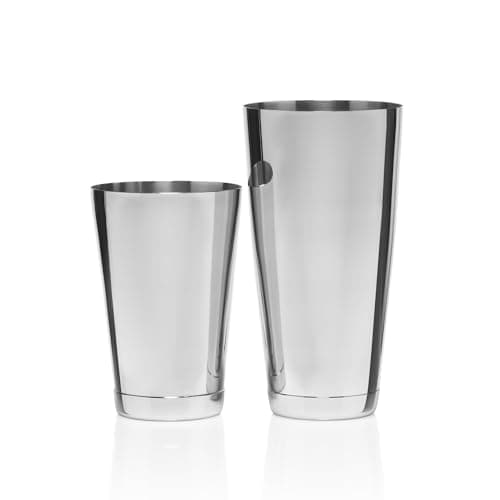 Cocktail Kingdom Koriko Weighted Shaking Tins The default weighted pair | The default upgrade | $26.98 View on Amazon #ad how we are funded - price as of October 10, 2026 |
| 2 | 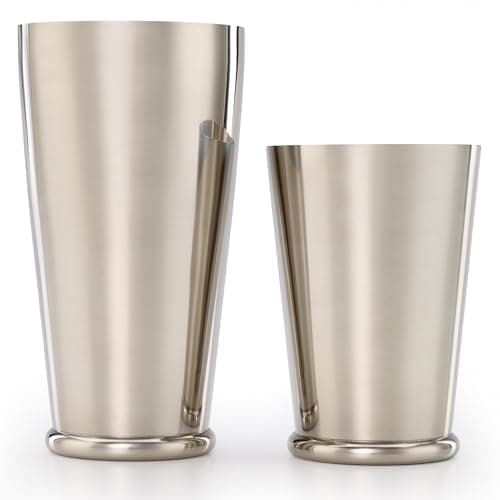 Barfly Deluxe Weighted Cocktail Shaker Set A weighted pair for less | A weighted pair for less | $37.03 #ad how we are funded - price as of October 10, 2026 |
| 3 | 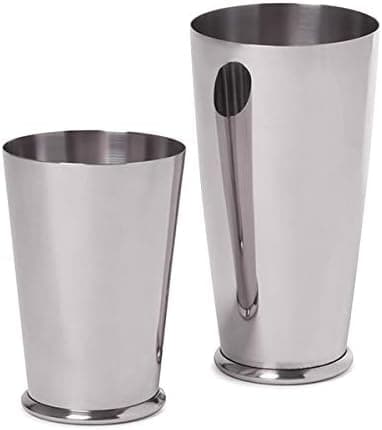 Cocktail Kingdom Leopold Weighted Shaking Tins If the tins are on display | When the tins are on display | $31.99 View on Amazon #ad how we are funded - price as of October 10, 2026 |
| 4 | 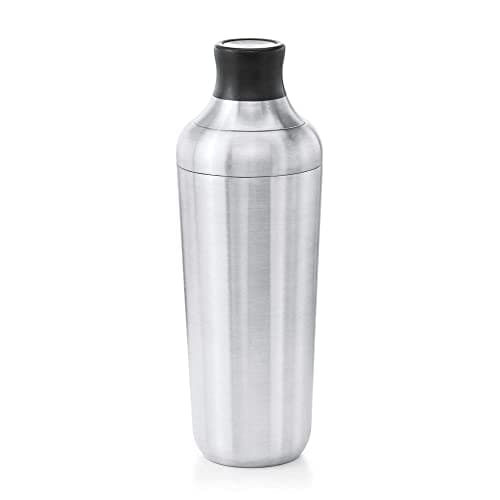 OXO Steel Cocktail Shaker with Strainer If you do not want tins at all | Handing to a guest | $28.62 #ad how we are funded - price as of October 10, 2026 |
Scroll the table sideways on a narrow screen. Every price in this table comes from Amazon’s own product data, is refreshed daily, and is stamped with the date it was read - and the button opens the current listing, which is always the final word.
The short version
Side by side
| Weighted tins | Unweighted tins | |
|---|---|---|
| Where the mass is | Cast into the base | Nowhere - uniform thin wall |
| Empty tin on a wet counter | Stays put | Slides |
| Breaking the seal | Strike the heel against the base - consistent | Less to strike against, more wrist |
| Building a drink into it | Stands up to a pour and a stir | Tips easily when part full |
| Dent resistance | Better - heavier gauge in the stress area | Dents on a dropped corner |
| Weight to shake | Heavier in the hand | Lighter - faster for high volume |
| Throwing drinks | Workable | Preferred by some bartenders |
| Typical set | 18 oz and 28 oz | 18 oz and 28 oz |
| Cost | Entry to step up | Cheapest tins available |
Note what is not on that list: the seal itself, and how well the drink chills. A weighted tin does not seal better than an unweighted one of the same geometry - the seal comes from the taper, which is a separate manufacturing question, and a badly cut weighted tin is worse than a well cut light one. Weight is about handling, not about sealing. Why shaker tins stick and leak is the page on the seal itself.
Difference 1
What the weight actually is, and where
A weighted tin is not thicker all over. The extra mass sits in the base - a thickened, often cast heel that adds several ounces at the bottom of the tin and nowhere else. You can feel it immediately: set a weighted 28 oz tin on a counter and it has the dead stability of a glass tumbler rather than the tinny lightness of a cup.
That low centre of mass is the whole feature. It means a part-full tin does not tip when you knock it with a bar spoon, an empty tin does not slide when you set it down wet, and the tin stays vertical while you free-pour into it with the other hand. None of these sound like much individually. Together they are the difference between a tool that cooperates and one that needs watching.
The second effect is on breaking the seal. A sealed pair of tins is opened by striking the heel of your hand against the side of the large tin at the point where the small one is wedged, which shocks the two apart. A weighted base gives that strike a solid, inert object to work against instead of a flexing wall, which is why the break on a good weighted pair is a single confident tap rather than three nervous ones. How to shake a cocktail covers the motion, including the break.
Difference 2
The case for unweighted, made honestly
There is one, and it is about speed. Unweighted tins are lighter, which means less work per shake and less fatigue across a long service, and that matters enormously in a busy room and not at all at home. A bartender making four hundred drinks in a night has a different relationship with four extra ounces in each hand than someone making two on a Friday.
They are also the tins of choice for throwing drinks - the technique of pouring a liquid in a long arc between two tins to aerate it. Throwing wants light tins you can hold at arm's length and control precisely, and weighted bases are dead mass in that motion. If you throw, you know this already.
And they are cheaper, which is a legitimate reason to buy anything. The problem is that unweighted tins are usually cheaper in two ways at once: less mass and thinner gauge. Thin-gauge steel dents on a dropped corner, and a dented tin is a tin that no longer seals, because the seal depends on two circular edges meeting cleanly. That failure mode is permanent and it is why a cheap pair of tins can become unusable in a month.
A tin and a pint glass - the original Boston shaker - is the other unweighted configuration, and it is a genuinely bad idea at home. Glass against metal is a worse seal, and the glass half breaks. If you want two-piece shaking, buy two tins.
Difference 3
Capacity is the same decision either way
Weighted or not, the standard pair is 18 oz and 28 oz, and that is not arbitrary. The 28 oz tin holds two drinks plus a full ice charge with room for the ice to actually move, which is what a shake is for. The 18 oz tin is both the lid and the vessel you build into, and the diameter difference between the two is what creates the wedge that seals them.
That means capacity is not where you economise. A smaller pair shakes one drink and crowds at two; a larger pair is awkward in a normal hand. If you regularly make four drinks at once, the answer is two 18/28 pairs rather than one enormous tin, which is also faster, because you can shake one while the other drains. What size cocktail shaker is the capacity question in full, and what size ice for a cocktail shaker covers the ice charge that fills it.
Both configurations need a separate strainer, because tins have no built-in one. That is a feature rather than an omission - a Hawthorne strains far better than anything built into a lid - but it is a second purchase, and it is worth factoring in when you compare a tin pair against a cobbler. Best cocktail strainers and how to use a Hawthorne strainer cover that half of the kit.
The verdict
What we would actually buy
Weighted, in 18 and 28 oz, from a maker whose taper is known to be consistent. That is the Koriko pair as a default, the Barfly Deluxe set if you would rather spend less on the same idea, and the Leopold pair if the tins sit out where people see them. The weight is worth the few extra dollars because the handling benefits show up on every single drink, and because heavier gauge in the base is also the part that survives being dropped.
The one group we would steer away from tins entirely is people who do not actually want to learn the seal. Tins are a two-handed tool with a technique attached, and a weighted pair makes that technique easier rather than unnecessary. If the person making drinks in your house changes from night to night, a cobbler with the strainer in the lid is the better object, and nobody has to be shown how to break a seal. Boston vs cobbler shaker is that decision, and best cocktail shakers for beginners is where to start if tins feel like a step too far.
If you already own unweighted tins and they work, keep them. A pair that seals cleanly and breaks reliably is doing its job, and swapping to weighted is an upgrade in handling rather than a fix for a problem. Replace them when they dent, not before. Best weighted shaking tins is the roundup when that day comes.
The picks in full
Every pick, and who each one is for
01 · The default weighted pair
Cocktail Kingdom Koriko Weighted Shaking Tins
Cocktail Kingdom · Mid tier
#ad how we are funded - price as of October 10, 2026
The tins most working bartenders reach for, and the shortest path out of a shaker that sticks.
18 and 28 oz, weighted bases, and a taper cut so the pair seals with a tap and breaks with a palm strike every time. The most predictable seal in the category and the shortest path out of a shaker that fights you.
The specs that decide it
- Set:
- 18 oz and 28 oz
- Capacity:
- about 2 drinks
- Base:
- weighted
- Material:
- stainless steel
Who it is for
- The taper is cut so the pair seals with a tap and breaks with a palm strike, every time
- Weighted bases keep an empty tin from skating across the counter
- Cheap enough to own two pairs, which is how you actually make four drinks
Where it gives ground
- The seal is tight by design and feels alarming for the first week
- Bare steel shows fingerprints immediately
Skip this one if you want a one-piece shaker you can hand to a guest. Tins are a two-handed tool and they reward practice.
02 · A weighted pair for less
Barfly Deluxe Weighted Cocktail Shaker Set
Barfly by Mercer · Mid tier
#ad how we are funded - price as of October 10, 2026
Heavy-gauge weighted tins from a professional kitchen brand, at noticeably less than the bartender-shop pairs.
18 oz and 28 oz in heavy-gauge steel with a weighted bottom, from a professional kitchen brand, at noticeably less than the bartender-shop pairs. The large tin is 6.75 inches tall and 3.75 inches across.
The specs that decide it
- Set:
- 18 oz (532 ml) and 28 oz (828 ml)
- Material:
- stainless steel
- Base:
- weighted bottom
- Size:
- 6.75 in tall by 3.75 in across the large tin
Who it is for
- Heavy-gauge steel feels more substantial in the hand than the price suggests
- A weighted base is the whole point of a tin pair, and this one has it at the lower price
- Satin interior wears well rather than scratching to a dull gray
Where it gives ground
- Only sold in plain stainless, so there is no finish to match a copper or black bar
- Seal feel varies a little more pair to pair than the Cocktail Kingdom tins
Skip this one if you want the single most predictable seal available. Plain Koriko tins are the safer default.
03 · If the tins are on display
Cocktail Kingdom Leopold Weighted Shaking Tins
Cocktail Kingdom · The step up
#ad how we are funded - price as of October 10, 2026
The same working geometry as the Koriko in an art deco dress, for a bar where the tools sit out.
The same working geometry as the Koriko in a fluted deco pattern, and the fluting grips better in a wet hand. Worth it on an open bar cart, pointless in a drawer.
The specs that decide it
- Set:
- 18 oz and 28 oz
- Capacity:
- about 2 drinks
- Base:
- weighted
- Styling:
- fluted deco pattern drawn from 1920s-30s pieces
Who it is for
- Looks like something rather than like equipment, which matters on an open bar cart
- Fluting gives a grippier hold with wet hands than a smooth tin
- Seals and breaks the same way the plain tins do
Where it gives ground
- The pattern traps a little more residue, so it wants a brush rather than a rinse
- You pay for the styling, not for performance
Skip this one if your tins live in a drawer. You will be paying for a finish nobody sees.
04 · If you do not want tins at all
OXO Steel Cocktail Shaker with Strainer
OXO · Entry tier
#ad how we are funded - price as of October 10, 2026
A cobbler that seals and pours without a fight, for the times when the person shaking is not you.
A 24 oz cobbler with the strainer in the lid - one object instead of three, and the thing to hand a guest. The honest alternative to a weighted pair, rather than a lighter pair of tins.
The specs that decide it
- Type:
- cobbler, three-piece
- Strainer:
- built into the lid
- Material:
- stainless steel
- Capacity:
- 24 oz
Who it is for
- Built-in strainer means one object, not three, which is what makes it guest-proof
- Seals reliably - the failure mode of cheap cobblers is a lid that freezes on, and this is not one
- Dishwasher tolerant
Where it gives ground
- Built-in strainer is coarser than a real Hawthorne
- Capacity caps out well below a 28 oz tin
Skip this one if you are the only person who ever makes drinks in your house. Tins are faster, hold more and strain better.
Honest limits
What we could not verify
We do not list an unweighted tin pair on this page, because we would not recommend one for a home bar, so the unweighted column here describes the category from its construction and from consistent bartending practice rather than from a specific product we have specified. No maker publishes the mass added by a weighted base, so the weight difference is described qualitatively rather than in ounces. We have not dent-tested tins or measured seal force, so the durability and break arguments rest on gauge and geometry rather than on our own testing.
We do not run a test lab and we have not personally used every product here. Where a judgment rests on published specifications or on what owners report rather than on our own hands, we say so. Read the full method.
Questions
Related questions
- What does weighted mean on a cocktail shaker tin?
- Extra mass cast into the base of the tin, not thicker walls throughout. It lowers the centre of gravity, so the tin stays put on a wet counter and upright while you pour into it, and it gives the heel of your hand something solid to strike against when you break the seal.
- Are weighted shaker tins better than unweighted?
- For a home bar, yes - they handle better on every drink and the heavier base survives being dropped. Unweighted tins are lighter and faster across a long service, which is why some working bartenders prefer them, and they are the right choice for throwing drinks. Weight does not change how well a pair seals; the taper does.
- Do weighted tins seal better?
- No. The seal comes from how the two tins are tapered, which is a separate manufacturing question from weight. A badly cut weighted pair seals worse than a well cut light one. What the weight improves is breaking the seal, because the strike has a solid base to work against.
- Why do cheap shaker tins stop working?
- They dent. Cheap tins are usually both unweighted and thin-gauge, and a dent anywhere on the rim means the two circular edges no longer meet cleanly, which is the end of the seal. It is permanent, it cannot be straightened reliably, and it is the main reason a budget pair can become unusable within weeks.
- What size weighted tins should you buy?
- 18 oz and 28 oz, which is the standard pair. The 28 oz tin takes two drinks plus a full ice charge with room for the ice to move; the 18 oz tin is the lid and the vessel you build into. If you often make four drinks, buy two pairs rather than one bigger tin.
- Do shaker tins come with a strainer?
- No. Tins have no built-in strainer, so you need a separate Hawthorne, and a fine mesh strainer too if you double strain. That is a genuine advantage over a cobbler - a real Hawthorne strains better than any lid - but it is a second purchase to budget for.
Read next
Related reading
- Shakers and strainers
Weighted tins, cobblers and strainers, ranked on the thing that actually matters: whether the seal behaves.
- Best weighted shaking tins
Two-piece tins compared on seal behavior, capacity pairing, balance and edge finish.
- Why shaker tins stick and leak
Sticking is the seal working, leaking is the seal failing. How to tell a technique problem from a bad pair.
- Boston vs cobbler shaker
Two tins against three pieces, on capacity, chilling, straining and who is doing the shaking.
- What size cocktail shaker do you need
Why 18 and 28 is the pairing, what a tin really holds with ice, and why two pairs beat one big one.
- How to shake a cocktail
Sealing, the shake itself, when to stop, and breaking the seal in one motion - plus dry shake and whip.